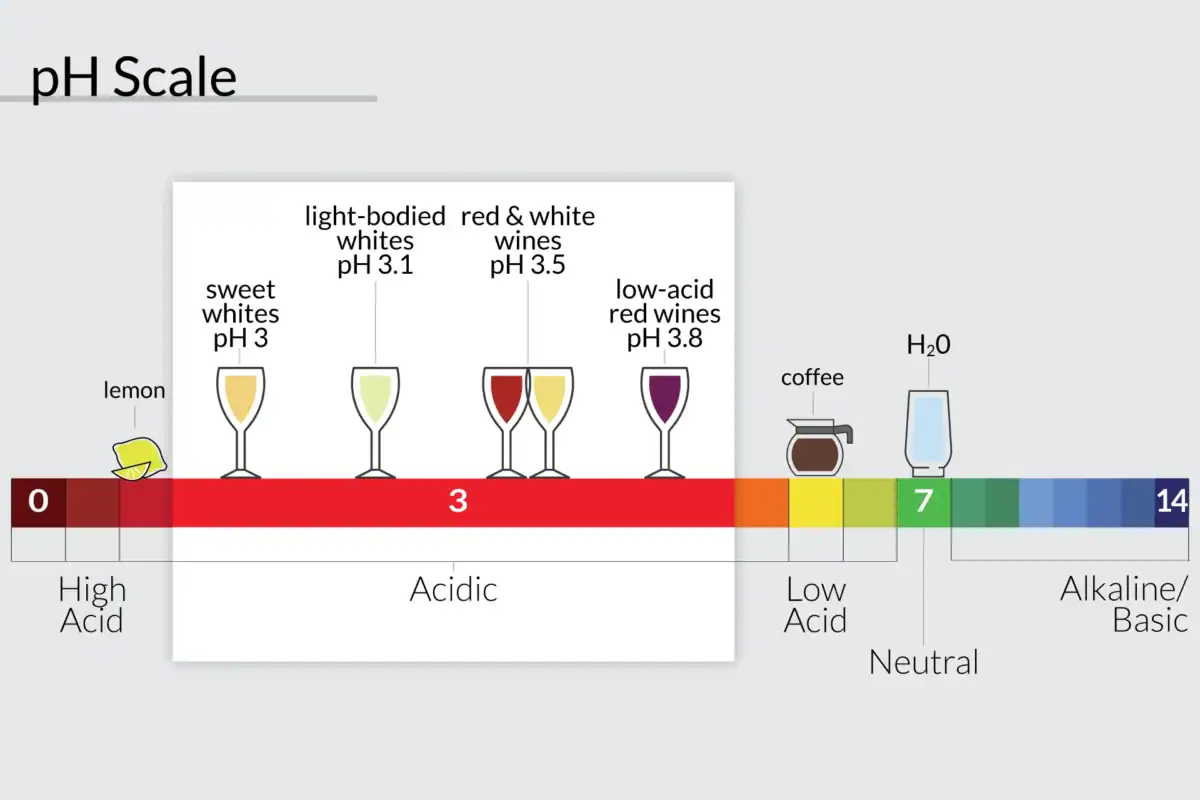
pH is a measure that indicates acidity or basicity on a scale of 0 to 14. A pH of seven is neutral, below seven is acidic and above seven is basic; however it’s important to note that pH is measured on a logarithmic scale, so a pH of three is actually 10 times more acidic than a wine with the pH of four.
High pH wine (low acidity) pH 3.8+ :
- Will be more susceptible to the growth of unwanted bacteria that can lead to spoilage and oxidation. That translates to a wine that won’t age well.
- Can lead to color loss and loss of vibrancy.
- Often lacks that sharpness or crispness and freshness in wine. The word “flabby” comes to mind.
- Augments off-flavors like musty notes.
- Results in less complex wines.
Low pH wines (higher acidity) pH 3.4-3.7
- More vibrant colors
- More pronounced fruit flavors and aromas
- Greater complexity
- More crispness and freshness
- Greater longevity
So, how do you know a wine with a low pH versus a wine with high pH? Frankly, you won’t find it on the bottle’s label. You should find it on the wines’ tech sheets assuming that they are on the winery’s website.
Here are Sixmilebridge, we are blessed with vineyards and climatic conditions that preserve the acidity in our fruit. We don’t add acid, because we don’t need to. Our wines are typically in the 3.4-3.6 pH range. You can find the pH for all our wines at the bottom of the wines’ tech sheets on our website.
So when you open a bottle of our red wine, you should expect deep color, vibrancy, strong aromatics and full flavors that come together to give you a wine with complexity that, if properly stored, will age 10-15 years.
Slainte,
